
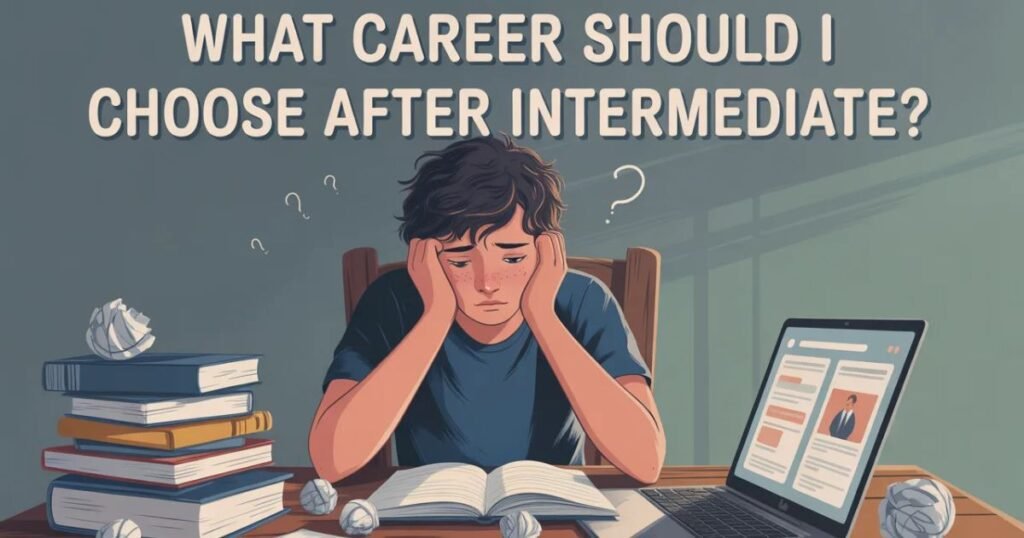
I started FobiaJobs because of one simple reason. I watched too many students around me, including myself, feel completely paralyzed after intermediate. Not because we were not smart. Not because we did not care. But because nobody gave us a clear, honest answer to the one question that kept us up at night:
What career should I choose after intermediate?
Your parents say one thing. Your relatives suggest another. Your friends are all going in different directions. And somewhere in the middle of all that noise, you are sitting there wondering what YOU want!
If that sounds familiar, take a breath. You are not lost. You are just not being guided properly.
This article is not going to give you a list of random career names and pass them off as guidance. Instead, we are going to go through this properly – understanding yourself first, looking through the lens of real options, making sure you avoid common mistakes, and actually building a direction in which you feel confident.
By the time you finish reading this, you will have some definite starting point. Let’s get into it.
Why So Many Students Feel Stuck After Intermediate

Most career guides skip this part. They jump straight to listing career options without explaining why you feel stuck in the first place. That is a mistake, because if you do not understand the root of your confusion, you will stay confused no matter how many articles you read.
Here is the real reason that most students struggle:
You have spent your whole academic career being told what to study and when to study, what to aspire to, etc. Suddenly, after the intermediate, all of that structure is gone, and you’re supposed to completely make a decision to change your life all by yourself.
On top of that:
- Society pushes certain careers as “respectable” (doctor, engineer, banker) and turns a blind eye to everything else
- Parents tend to invest their own unrealized dreams into their children
- Comparing yourself to friends creates panic, not clarity
- The internet gives you a hundred options, but zero direction
The result? Paralysis. Overthinking. Delay. Sometimes the wrong choice is made out of pure pressure.
Understanding this is step one. Because once you realize that your confusion is normal and has nothing to do with your intelligence or potential, you can move forward with a clear head.
Step 1 — Understand Yourself Before You Research Careers
Every online career guide tells you to “research career options.” But here is the problem – if you don’t know yourself in the first place, you will research blindly, and you will still end up confused.
Before looking forward. Ask yourself these three questions:
What do you do well without much effort?
Not the thing you studied the hardest, think about the things that were easy or fun for you. There’s a big difference.
Take a moment and remember your last few years. What subjects, tasks, and activities did you like to do without forcing yourself? What did the people around you say you were really good at?
Here are some examples:
- Got numbers, thinking things through, spotting sequences? That points to finance, handling information, building systems, and writing code
- Stories, words on paper, become blogs that teach or sell. Explaining ideas clearly might mean marketing work or classroom lessons. Telling a tale can turn into shared posts online. Writing shows up everywhere people need understanding
- Drawing Design Aesthetics? Graphic design, UI/UX, or fashion may be a good fit.
- People who chat well often hear more than they speak. Jobs like selling stuff rely on that skill a lot. Human resources work needs patience when others talk. Therapists build their whole job around quiet attention. Shaping how groups see an organization ties back to real conversation
- Hands-on tasks like assembling or repairing things often lead to jobs in construction. Fixing machines might mean a path toward being a mechanic. Working with tools can pull someone into trade work. Engineering sometimes follows when building solutions feels natural. Crafting structures or systems shapes careers in these fields.
What do you actually enjoy — NOT what sounds impressive?
A career that impresses others but bores you will suck the life out of you in a year. A career that you profoundly enjoy will want you to grow even on hard days.
Sit down and write five things that you like to do even when no one is watching, and no one is paying you. Those five things carry more career truth than any aptitude test.
What kind of Life do you want?
Most students think about job titles. Very few think about the life that comes with that job. But your lifestyle matters as much as your career choice.
Ask yourself these questions:
Do I want to work from home or in an office?
Do I want a fixed salary or freedom to earn based on my performance?
Do I want low stress and stability, or am I okay with high pressure for high reward?
Do I want to work for others or run my own business?
Your truthful answers to these three questions will guide you to a better career category than any online quiz.
Step 2 — Match Yourself to a Career Category

With a clearer picture of who you are, matching your path to a fitting kind of work becomes easier. These are not just job names — they are directions.
Technology and Digital Careers
Logic lovers find their groove here. Figuring things out comes naturally to these minds. Computers spark curiosity rather than confusion. Picking up new software feels like a puzzle being solved. Tools become second nature without much effort. Learning curves flatten when interest runs deep
A few of these need a diploma – what counts is your ability, along with solid examples of past work.
- Web Development with HTML, CSS, and JavaScript
- Graphic design with Canva, Photoshop, and Illustrator
- Online promotion includes search engine tricks. Social platforms help spread messages. Paid spots grab attention fast
- Video Editing with Premiere Pro, CapCut, DaVinci Resolve
- UI UX design with Figma and Adobe XD
- Data entry and virtual assistant tasks
Finding jobs like these is getting easier across countries. With internet courses, it’s possible to pick up the skills needed. Doing focused training for a few months opens doors to income. Remote work fits naturally into this path once you’re ready.
Business & Finance Careers
Best for: organized people, those who like strategy, numbers, and management
- Accounting and Finance
- Business Administration (BBA)
- Banking and Financial Services
- E-commerce and Online Business
- Supply Chain and Logistics
These careers often require a degree but offer strong long-term stability and growth.
Creative Careers
Best for: imaginative people, those who express themselves through art, visuals, or words
- Content Writing and Blogging
- Photography and Videography
- Social Media Management
- Fashion Design
- Animation and Motion Graphics
Many creative careers have gone fully digital, which means global opportunities from wherever you are.
Education & People-focused careers
Best for: natural communicators, empathetic people, those who love guiding others
- Teaching and Tutoring
- Counseling and Psychology
- Human Resources
- Public Relations and Communications
- NGO and Social Work
These careers bring deep personal fulfillment and are always in demand.
Step 3 — The One Mistake Most Students Make

This is something no other career guide will tell you straight:
Most students decide on a career based on what the word sounds like, rather than what the word is. They hear “digital marketing” and think of doing marketing on Instagram all day. They hear “web development” and imagine coding is some kind of billion-dollar app.
Reality is always more layered than the title. Before settling on any career path, take 30 minutes of your time to do the following:
- Search YouTube: “Day in the life of a [career name]” — watch at least 2 videos.
- Read real experiences at Reddit in communities such as r/careerguidance or r/jobs.
- Look at actual job listings on LinkedIn for that career – read what skills and tasks are required.
If possible, a 15-minute chat with one person already working in the same field. This little piece of research will show you whether it was a good idea and you chose the right path, or it will save you years of going in the wrong direction. Both of these outcomes are equally valuable.
Step 4 — Test Before You Commit
Here is a mindset shift that will remove most of your career anxiety:
You do not need to commit fully to a career before you try it.
Most students think career decisions are permanent. They are not. But more importantly, you can test any career before committing a single rupee or year to it.
Here is how:
- Take a free short course via YouTube or Coursera in that field (1 to 4 weeks)
- Do one small real project — write an article, design a logo, or edit a video
- Offer your services for free to a local business or NGO for a month
- Start a small personal project — a blog, a social page, or a portfolio
After just 30 days of real testing, you will know more about whether that career suits you than any counselor, parent or guide ever could.
This approach also removes the pressure. You are not deciding your whole life — you are just trying something. That mental shift alone makes it so much easier to take the first step.
Best Beginner-Friendly Career Options After Intermediate in 2026
If you are still unsure where to start, here are the most practical and in-demand career paths for students right now — especially those who want to start without a degree or with zero experience:
| Career | Skills You Need | Time to Get Started |
| Freelance Writing | Writing, basic research | 3 to 6 weeks |
| Graphic Design | Canva, Adobe tools | 6 to 10 weeks |
| Digital Marketing | SEO, social media basics | 6 to 10 weeks |
| Video Editing | CapCut, Premiere Pro | 4 to 8 weeks |
| Web Development | HTML, CSS, JavaScript | 3 to 6 months |
| Data Entry | Typing speed, MS Office | 1 to 3 weeks |
| Virtual Assistant | Communication, organization | 1 to 3 weeks |
| Content Creator | Confidence, consistency, camera | Start today |
All of these can be learned for free through YouTube. All of them can be started from home. And all of them have real income potential within the first few months if you stay consistent.
Frequently Asked Questions(FAQs)
What is the best career after intermediate for a student with no experience?
The easiest careers to get into after intermediate include freelance writing, graphic design, data entry, virtual assistant work, and video editing. None of these involves a degree or previous experience. You can learn each of them online for free and begin building actual skills in a matter of weeks.
1) How do I Know What is the Right Career for Me?
Ans: Start by pinpointing what you are good at naturally, what you are really interested in, and what kind of lifestyle you want. Then try out your shortlisted careers with free courses or small real projects before you commit. Clarity always comes not from thinking but from action.
2) What if I pick the wrong career?
Ans: You will not ruin your life. First of all, FobiaJobs is always available for you. You can Visit Our Career Guidance For Depth Guidance or Contact Us. What is important is that you remain curious, continue to learn, and do not let fear of being wrong prevent you from getting started. Every experience is something that will teach you something useful, even if you end up changing paths.
3) Can I have a good income with no degree after intermediate?
Ans: Absolutely. Thousands of freelancers, digital marketers, content creators, and designers, all over the world, make a lot of money without having a traditional degree. Skills and a portfolio count for much more in most digital and creative fields today.
4) How long does it take to become all set for a career after intermediate?
Ans: For digital and skill-based careers, most people are prepared to begin earning after 1-6 months of serious learning. Traditional professions such as medicine or engineering involve more years of educational investment. The keyword in both cases is focused – consistency beats talent every time.
Conclusion
Choosing a career after intermediate is not something you need to get perfect on the first try. What you need is a starting point — one honest direction based on who you actually are, not who others want you to be.
Start by understanding yourself. Match your strengths to a career category. Research it for real, not just by reading article titles. Then test it with action before fully committing.
Career Clarity does not come from thinking more. It comes from doing more.